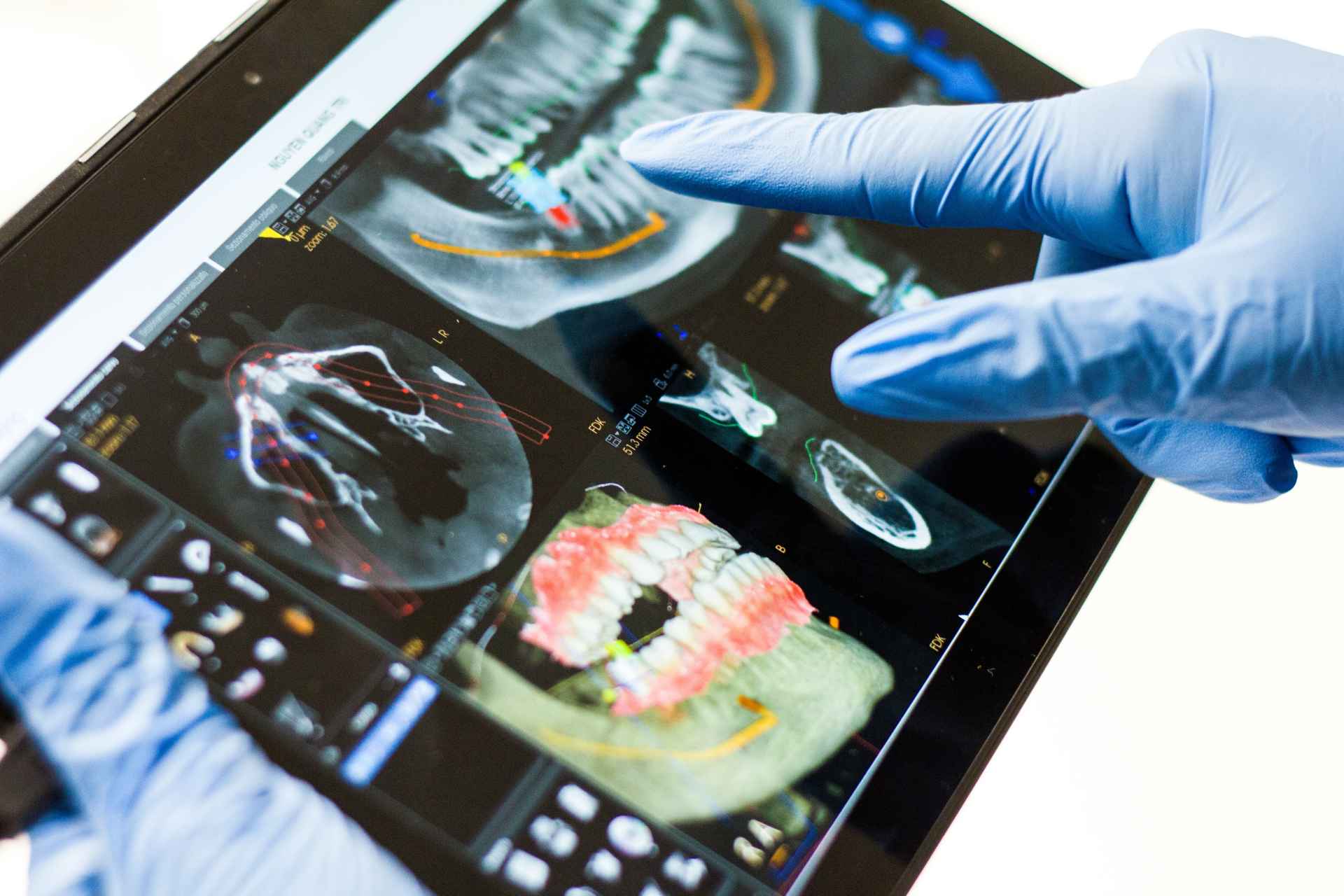
Oral and Maxillofacial Surgery
A dental specialty that diagnoses and performs necessary surgical treatments for diseases seen in the teeth, jaw and surrounding tissues.
Impacted Teeth
Teeth that have failed to break through the overlying bone, gum tissue or both after formation and have not reached their intended position in the mouth. Most commonly seen in wisdom teeth, canines and premolars.
Treatment: Teeth are guided to their correct position through surgical and orthodontic approaches. Tooth extraction is performed when orthodontic correction is not possible.
Wisdom Teeth
The last teeth to emerge and the furthest back in the mouth. Due to their location in hard-to-reach areas for brushing, they cause decay, gum inflammation, pain and bad breath.
They may not fully emerge due to insufficient space in the jaw:
- Fully impacted: Below the bone and gum tissue
- Partially impacted: Below gum tissue only, partially exposed to the oral environment
Partially impacted wisdom teeth cause plaque accumulation and food impaction, leading to an infection known as Pericoronitis. Symptoms include swelling, redness, neck and ear pain, swollen lymph nodes, and pain when opening the mouth or swallowing.
Treatment: A 25–30 minute operation under local anesthesia. The area is closed with sutures after the operation, which are removed one week later.
Dental and Jaw Cysts
Usually tooth-related, fluid-filled formations that develop in the jawbone or jaw soft tissues. If left untreated, they grow causing swelling, pain, loosening and displacement of adjacent teeth. They can lead to complications such as infection, bone resorption, bone fractures, nerve compression and numbness.
Treatment: Removal of the cyst sac under local anesthesia, disinfection of the area and closure with sutures. In some cases, filling with biomaterials such as bone powder and membranes is performed.
Apical Resection
A surgical procedure in which a cyst or infection at the tip of the tooth root is removed along with the lower third of the root. Performed to save the tooth.
Indications:
- Small cysts at the root tip
- Root tip infections unresponsive to root canal treatment
- Cases where an endodontic instrument has fractured at the root tip
- Overfilled root canal treatments
- Root tip fractures following trauma
Local anesthesia is applied. The bone surface is opened to access the root tip. Inflamed tissue is cleaned. A portion of the tooth root is cut and removed. The root tip is filled with special materials.
Blood and Growth Factor Concentrates (PRP/CGF-CD34)
The application of platelet cells found in the blood to treatment. The growth factors they contain provide regenerative treatment potential in wound healing.
PRP: Platelet Rich Plasma
CGF: Next-generation technology — used alone or combined with other biomaterials.
Since it is obtained from the patient's own blood, there is no risk of allergic reaction or infection.
Applications:
- Bone augmentation procedures
- Sinus lifting
- Socket preservation after tooth extraction
- Filling impacted tooth extraction cavities
- Filling cyst cavities
- Treatment of gum recession
- Treatment of nerve damage
- Treatment of joint diseases